

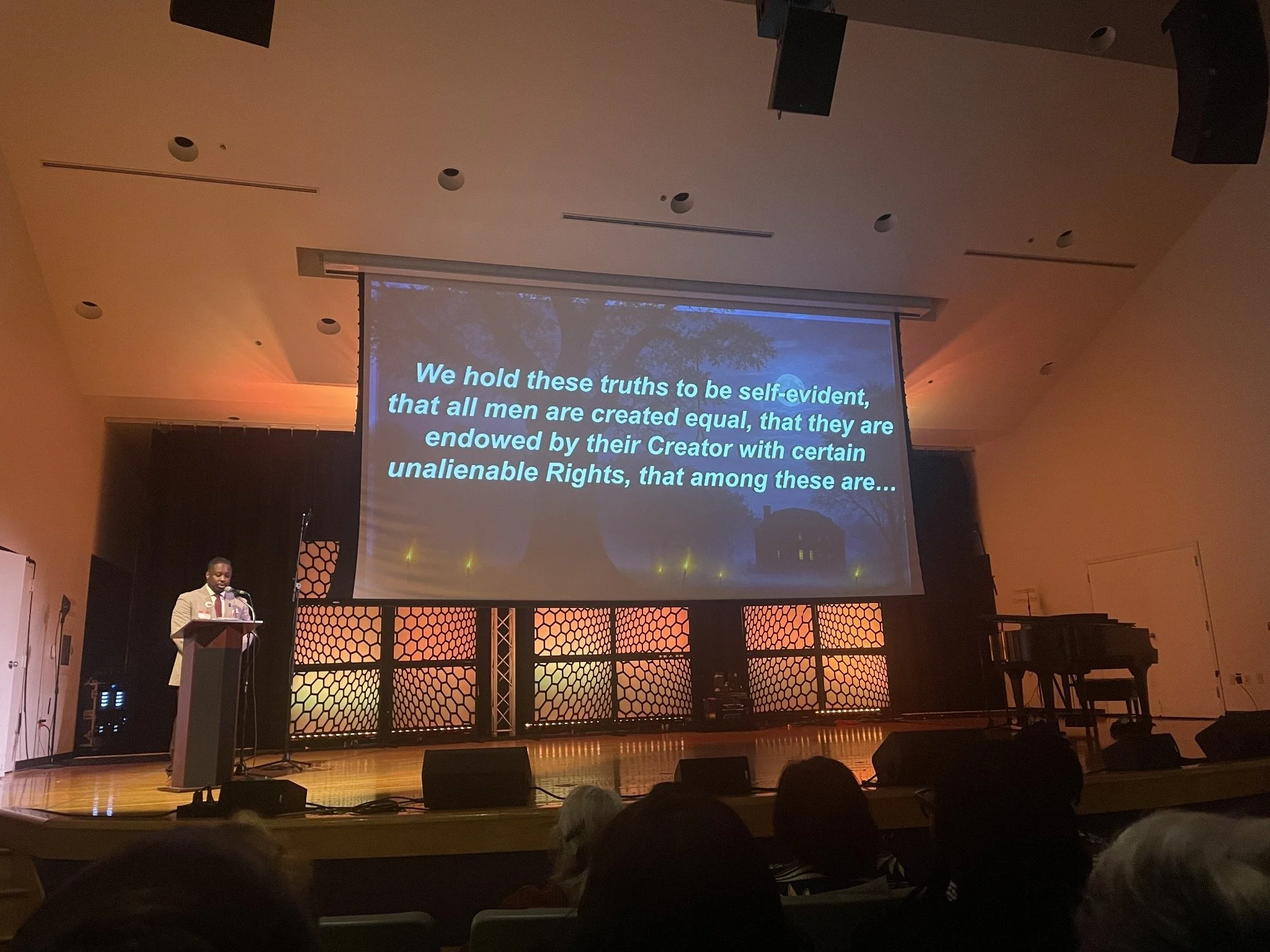
John-Phillip “JP” Williams — an independent genealogical researcher, reparations advocate, and member of the Prince George’s County Memorial Lynching Project — gives a presentation on John Henry Scott, a Black man that was lynched in Prince George’s County, Maryland in 1875, on Oct. 30 at Harmony Hall Arts Center in Fort Washington, Maryland (Prince George’s County). During his talk, Williams wept as he gave the presentation.
On Oct. 30, As John-Phillip “J.P.” Williams stood upon the stage and recited a very important part of Prince George’s County history, he could barely do so. Between sentences and paragraphs, he was restraining himself from weeping.
“ Take your time,” someone loudly and yet calmly said from the audience. Such a statement in the Black community acknowledges the difficulty and pain of a task that one is engaged in. It also says we (or I) will be patient and walk alongside you as you struggle through this moment.
Williams – an independent genealogical researcher, reparations advocate, and member of the Prince George’s County Memorial Lynching Project – is there because he has the mournful responsibility of recalling the history of John Henry Scott, a Black man who was lynched in 1875. Researchers have confirmed that the catastrophic event occurred Oxon Hill, Maryland.
The Prince George’s County Memorial Project is hosting this event. It’s a memorial service for Scott. “ In our culture, we really value honoring the dead and how we bury them,” said Williams. “When you think about a holiday like Memorial Day that was created by African Americans to memorialize a lot of the soldiers who did not get a proper burial.”
The service was held at Harmony Hall Arts Center at 10701 Livingston Rd Fort Washington, Maryland. It’s the organization's second memorial service for Black men that were lynched in Prince George’s County, Maryland. Its first was for Thomas Jurricks.
The service was saturated in the Black humanities: singing by The Frederick Douglass High School choir, a libation ritual by Dr. Lois Rosado, who used dirt for the ritual, poetry titled “ They build Walls, We Breathe Smoke” readvby Isaiah Ali, a student at Frederick Douglas High School, a dance performance by Lena Pitts, student at Suitland High School, a sermon/ lecture by Dr. Erika D. Gault, director of the center for the study of African American religious life and the Lilly Endowment Curator of African American Religious History at the Smithsonian National Museum of African American History and Culture, and lastly the calling of the names by Amirah Ajibola and Sanaa Green.
The memorial service was characterized by joy and mourning. Krystina Tucker, one of three co-chairs of the Prince George’s County Memorial Lynching Project, said they wanted to remember the life of the person, as is custom in Black memorial services.
I think it's really important that we show respect and honor to people who came before us, and in this moment, especially the ones who were unjustly lynched,” said Jolene Ivey, at-large councilwoman in Prince George’s County.
One the organizations core missions is to recover the truth about lynchings in Maryland and to, as much as possible, restore dignity to those who suffered injustice at the hands of white people. Depending on the timeframe organizations use to document the totality of Maryland lynchings, the number ranges from 38 to 46 Black men lynched. Out of those numbers, four Black men (Thomas Jurricks, Michael Green, Stephen Williams, John Henry Scott) were lynched in Prince George’s County.
Once enslaved, Scott had lived long enough to experience Maryland legally dismantle chattel slavery. However, socially, some white Marylanders’ found a way to skirt the law and still enslave some Black families and their children. As a free person, Scott worked on Notely Farm in Oxon Hill. That farm was owned and operated by Edgar and Aureila Neslon. Sometimes formerly enslaved people returned to their prisons camps. It’s not clear if this was Scott’s situation.
From all accounts, Scott wasn’t a problem for the Nelsons. They considered him a good worker. In short, Scott was accused of holding Aureila Nelson at gunpoint while her husband was in Washington, D.C. for business reasons. It is alleged that Scott held Mrs. Nelson at gun point on two separate occasions within the same night. Accounts of the events are mostly taken from the Baltimore Sun, and the Alexandria Gazette, who reported the accusations against Scott as if they were factually based. It seems that Mrs. Nelson may have accused Scott of raping her.
“Newspaper reports speculate that the reason for Scott’s acts ‘was he was tired of living, as his sister had become the mother of an illegitimate child and he was disgraced thereby,’” Williams recited during his presentation. However, according to Prince George’s County Lynching Memorial Project’s independent research, Scott did not have a sister.
After the accusation, according to Williams' presentation, The local Justice of the Peace “deputized” Curtis Smith to take Scott to the Prince George’s County jail. He never made it there. It is alleged that a multiracial mob - composed of white and Black people – stole him and hanged him from a black walnut tree until his breath vacated his body. Then they left him there to hang. Scott, Williams said, like the others that was lynched, “was somebody who was denied his constitutional rights to due process.”
Soldiers from Fort Foote, a Civil War outpost, found and cut him down from the tree. It’s not clear if the soldiers were intentionally searching for him, due to him being stolen, or happened to find him while in that area.
This memorial service occured at a time when Black men have been found hanging from trees. In September, a Black man was found hanging from a tree in Upper Marlboro. Additionally, in the last couple of months, a series of Black boys and men, according to Capital B, a national news service, have been found hanging from trees in the south and in California. Medical officials in those states, including Maryland, have ruled out the possibility of those men being lynched. They have categorized them as suicides.
“With everything that has been happening,...we wanted to bring joy to the work because that’s the only way you can kind of continue to do the work,” said Turner.
Lynchings have an over bearing impact on Black communities. Lynchings create an unwanted shock and compounded fear within the Black communities. “A lynching could be the impetus for why a family fled or moved from what had been their home for centuries,” said Michele Coles, Esq., commissioner on the Maryland Lynching Truth and Reconciliation Commission and author of “Black Was the Ink,” a young adult historical fiction novel about the Reconstruction Era, told The Intersection Mag last year before the Maryland Memorial Lynching Project held an event in southern Maryland that acknowledged those lynched in the region. “Now they’ve moved to Baltimore or… New York. They get away from the people in the places that hurt them.”
I asked Turner if she thought the Prince George’s County Memorial Project will discover more information about those who have been lynched. Turner said there is a possibility of more “untold stories” about lynching in the county. “I think four is just what we know for now, but there are just so many untold stories that we don't know about,” she explained. but there are just so many untold stories that we don't know about, and then the archives are bad. They're not all digitized, so unless we [actually] go to archives and do…[the] research, then we may not know.”
Read Our Other Coverage

Williams – an independent genealogical researcher, reparations advocate, and member of the Prince George’s County Memorial Lynching Project – is there because he has the mournful responsibility of recalling the history of John Henry Scott, a Black man who was lynched in 1875. Researchers have confirmed that the catastrophic event occurred Oxon Hill, Maryland.
The Prince George’s County Memorial Project is hosting this event. It’s a memorial service for Scott. “ In our culture, we really value honoring the dead and how we bury them,” said Williams. “When you think about a holiday like Memorial Day that was created by African Americans to memorialize a lot of the soldiers who did not get a proper burial.”
The service was held at Harmony Hall Arts Center at 10701 Livingston Rd Fort Washington, Maryland. It’s the organization's second memorial service for Black men that were lynched in Prince George’s County, Maryland. Its first was for Thomas Jurricks.