

Baby Bonds could be a solution to intergenerational poverty and closing the wealth gap in Prince George's County and Maryland
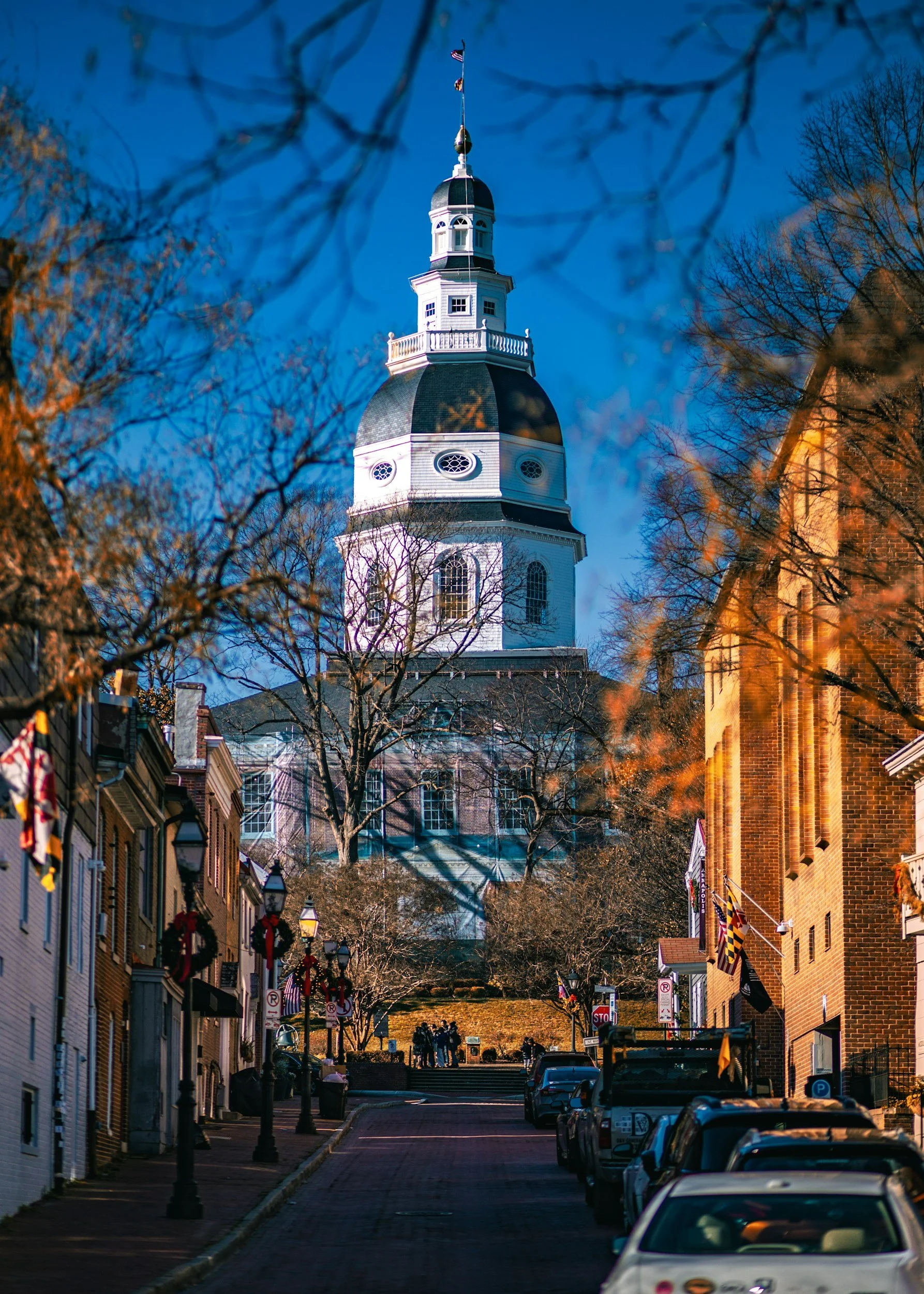
Photo of the Maryland’s state capitol building in Annapolis. Photo on Unsplash.com
“In other words, how are the cycles of poverty broken? Baby bonds could be a solution to breaking up intergenerational poverty in Prince George’s County and potentially the state.”
Capitol Heights, Maryland, a majority-Black town, straddles the border of Washington, D.C. (particularly its Southeast and Northeast quadrants). This suburb features a variety of housing styles, including bungalows, Cape Cod cottages, split-foyers, and ramblers—homes that have symbolized the promise of a stable middle-class lifestyle. The community's median household income is $97,155, slightly below the county median income of $101,798. While this income level can be considered economically comfortable for many residents, pockets of poverty remain deeply embedded within the community. According to the latest census, the poverty level is at 8.9%. The town could be considered a microcosm of the class stratification that encompasses all of Prince George’s County, a county composed of those who have and those who don’t.
Poverty is a problem in this town and in the state. While Maryland’s safety net programs – Supplemental Nutrition Assistance Program (SNAP), Temporary Cash Assistance (TCA) – provide help for families living in poverty, there is the question of how to solve intergenerational poverty. In other words, how are the cycles of poverty broken? Baby bonds or childrens savings pilot program could be a solution to breaking up intergenerational poverty in Prince George’s County and potentially the state.
In 2024, The Greater Washington Community Foundation, a DMV-based nonprofit organization, launched The Brilliant Futures initiative, a savings pilot program. The organization partnered with two elementary schools, Bradbury Heights Elementary school in Capital Heights, MD (Prince George’s County) and Jackson Elementary School in Silver Spring, MD (Montgomery County).
Darius Graham, former managing director of community investment at Greater Washington Foundation, said Montgomery and Prince George’s County are known for being wealthy. However, he said, “When we look at the data, there are wide wealth gaps. So while there is a lot of concentration of [wealth], there are also a lot of people who are not doing so well, financially.
Graham said the organization chose the two schools to test the program based upon their research. Both schools are title one schools. Title 1 schools exist within high-poverty neighborhoods or it serves families from communities that have been marginalized. He said, “ we felt like we could have a really big impact on outcomes from those communities.”
A children’s savings program always privately funded. Baby bonds, in short, are publicly, and sometimes privately, funded accounts. In both cases (child savings program and baby bonds), funds are placed into an account and over time it accrues interest. Beneficiaries of the accounts have access to funding, which can be used as a foundation for building wealth.
““...the Henry Cohen Prof. of Economics and Urban Policy at The New School for Social ResearchDarrick Hamilton used America’s history of public investment in its citizens to champion baby bonds for those pushed to the margins of society. Hamilton seems to be the first on this side of history to champion a nationwide policy as a solution to intergenerational poverty. Hamilton said that we can use baby bonds as a way to invest in children.””
The American government has a history of letting citizens purchase bonds. The history of a bond goes back to the Revolutionary War, where citizens could purchase a bond. That bond helped to fund the war. After the war, the government paid citizens the matured interest on the bond. The same thing happened during the Civil War. These kinds of investments helped to fund many other wars as well as building projects worldwide. However, in the 1930s, during the Franklin D. Roosevelt administration, bonds were used in a somewhat new way. The bond was used as a personal investment strategy for Americans during the Great Depression. Simply put, it was a way to get money back into the hands of some Americans who were suffering. During that time, a bond cost between $25 - $100. The bond would mature for 10 years and then those that purchased received the interest accrued on that bond. Due to the bond’s short term interest-maturity feature – it was titled a baby bond.
Literally, centuries later, the Henry Cohen Prof. of Economics and Urban Policy at The New School for Social Research Darrick Hamilton used America’s history of public investment in its citizens to champion baby bonds for those pushed to the margins of society. Hamilton seems to be the first on this side of history to champion a nationwide policy as a solution to intergenerational poverty. Hamilton said that we can use baby bonds as a way to invest in children.
***
The Brilliant Futures pilot program is a public-private partnership between the two schools and The Community Foundation. That foundation received millions of dollars in support and donations for the program through The Community Foundation’s Together, We Prosper Campaign For Economic Justice. Children at both schools aren’t automatically enrolled into the savings -pilot program. Parents have to enroll them.
“According to the Annie Casey Foundation’s 2024 data on child poverty in Maryland was a little over 11%, which is down from 12% in 2022. ‘Research shows that children raised in poverty are likely to be poor as adults, and that the transfer of poverty from one generation to the next is common,’ according to a study compiled by Maryland University’s School of Social Work.”
For those children who participate will receive $1,000 each year from kindergarten to 12 grade. The funds will grow over time – and the goal is for each student to graduate from high school with access to at least $13,000 in their accounts. These high school graduates will have opportunities to use that money to start a business; for education; homeownership; entrepreneurship. The hope is to give them the opportunities that their parents may not have had, and to ensure that they start on an economically firm foundation.
We asked the community foundation if we could interview some of the families participating in the program. We weren’t granted access to interview them.
Intergenerational poverty in Prince George’s County is only a mirror of the state’s poverty problem, one that the Moore administration has spoken about. According to the Annie Casey Foundation’s 2024 data, child poverty in Maryland was a little over 11%, down from 12% in 2022. “Research shows that children raised in poverty are likely to be poor as adults, and that the transfer of poverty from one generation to the next is common,” according to a study compiled by the University of Maryland’s School of Social Work.
Understanding poverty’s impact on residents in Prince George’s County and Maryland, Graham and other activists began to push for a statewide baby bond program.
In early 2025, Edelson, Graham, Tonaeya Moore, director of policy for the CASH Campaign of Maryland, a nonprofit that promotes economic advancement in the state, began to engage Maryland legislators on the idea of creating a state-funded baby bond program, according to Graham. Eventually, Edelson crafted House Bill 753, one that gave the comptroller authority to conduct a feasibility study on baby bonds. In December of 2025, Maryland Comptroller Brooke Lierman and her staff released their baby bond feasibility study. The study serves as an outline of its aspirations, which are to build a statewide baby bond program for low-income families. Maryland’s safety net programs can’t foot the bill for child and family poverty. “I understand that the income support programs that we have on the books already – Medicaid, Supplemental Nutrition Assistance Program (SNAP), Temporary Assistance For Needy Children (TANF) – are all really essential programs, but they don’t do enough to break the cycle of poverty, nor build wealth. They don’t tackle the challenge of intergenerational poverty nor the wealth gap we see in the United States and in Maryland,” said Lierman.
She also added that having a baby bond program could potentially move people away from the safety net program.
The report says that income interventions, for example, like tax credits don’t help Marylanders build wealth over time.
“While income-based interventions are important safety net protections that help individuals/families survive and meet basic needs, they are often not enough to help them get ahead. Building wealth is more powerful and longlasting: economic opportunity is unlocked, and upward mobility is achieved when people have enough resources to save and set aside money to invest in appreciable assets,” according to the report.
“I understand that the income supporting programs that we have on the books already – Medicaid, Supplemental Nutrition Assistance Program (SNAP), Temporary Assistance For Needy Children (TANF) – are all really essential programs, but they don’t do enough to break the cycle of poverty, nor build wealth. They don’t tackle the challenge of intergenerational poverty and nor the wealth gap we see in the United States and in Maryland.”
In short, the report makes a distinction between wealth and income. There is this belief that income is the only way to build wealth. David Radcliffe, director of state and local policy at the Race, Power, with New School’s Institute on Race, Power, and Political Economy, said that we often believe wealth is built through having a great job or as a result of receiving a formal education that leads to a well-paying job. “There may have been a time when one or more of those things may have been true,” said Radcliffe. “We all know people who are in those positions and yet still just struggling to get by.”
Radcliffe said in order to transition people into the domain of wealth, there has to be an intervention. “If we don’t intervene in a way that unlocks capital in the form of wealth for people, we will forever be on this treadmill of just helping people get by,” he said.
Additionally, the report shows that 78% of white people are homeowners compared to only 54% of Black people. However, perhaps where the gap is most seen is in different ethnic groups’ net worths. Black Marylanders’ net worth is about $109,898. For white people, it stands at $408,832, while Asian Americans lead with $450,500.
Maryland, a colonial Catholic colony at its founding, was one of the many places that trafficked Africans as property and for labor. Additionally, after emancipation, Baltimore became the first city in the country to legislate racialized housing practices. Likewise, neighboring Prince George’s County’s Black residents also experienced redlining, a form of legal segregation backed by the federal government. This is not to mention the economic impact of sundown towns and lynchings. These were all anti-Black and anti-wealth-building policies.
“These gaps [ between Black and White households] stem from years of federal, state, and local public policies and private practices rooted in racism and sexism that excluded or disadvantaged people of color and women,” according to the report. “For example, Social Security (as originally established in 1935) excluded domestic and agricultural workers, about half of whom identified as Black or women.”
Maryland and Prince George’s County are not alone in their baby bond journey. They have an example to follow. Connecticut is the first state to pass a baby bond program for families within its Medicaid system. In short, the state has promised to invest $3,200 into children born into poverty. According to the latest data, in 2024, child poverty in Connecticut was 13%. However, the overall state-level poverty rate is 10%.
Maryland’s baby bond program is still very much in its “design” stage, said Moore. This statewide legislation, if it were to pass the legislative process, would potentially – like Connecticut – target Medicaid recipients. As of 2025, according to Kaiser Health’s data, there are 1,496,000 children and adults enrolled in the Medicaid program. Children make up 36% of Medicaid recipients, and 42% of births are covered by Medicaid, who are mostly to Latino women. Maryland spends about $17 billion annually on the government program.
Lierman said the program could use Medicaid as an eligibility requirement. “So certainly Medicaid eligibility is a very good proxy,” said Lierman. “When legislation is introduced to create a baby bonds program, that may be the proxy that is used.”
Because there is no bill as of yet, Maryland legislators have room to think of other eligibility requirements that may not include Medicaid.“I think the sky’s the limit,” she said. “You could [use] any sort of proxy (eligibility requirement).
The bonds are not targeted toward any particular racial group, but will go to all children who are eligible. Lierman said the statewide program is different from those headed by local organizations. Following Connecticut’s baby bond program model, parents will not have to opt-into the program; they will be automatically enrolled based on eligibility requirements.
We want, Moore said, “to avoid any hurdles that families might experience” so that they can get on the path to building wealth.
She said they want to make sure that the amount of money invested in each family corresponds to Maryland’s cost of living and “the cost that it takes to attend a school or start a business.”
The program would invest $7,000 in each child. By the time the child graduates, the fund would grow to $22,000. Like the baby bonds program at Bradbury Heights Elementary, the funds would be used for initiatives that encourage long-term economic growth: buying a home, education, etc.
““...those funds can help really shape their mindset and help to increase, you know, their ability to think beyond where they are.””
Yolanda Johnson, the executive director of the Prince George’s County Court Appointed Special Council (CASA), a non- profit that works with children in the foster care system, said a baby bond program like this would especially benefit children in the foster care system. Young adults, who often age out of the foster care system, face economic instability. Additionally, during that time, this group faces difficulty attending college, according to the Hechinger Report, a nonprofit news organization that reports on education. Providing this group with the opportunity to access a baby bond, Johnson said, will “help them stabilize, not only financially, but mentally.” Johnson said this particular group’s lives are often shaped by childhood trauma. But with ongoing help, Johnson said, “those funds can really help shape their mindset and help to increase, you know, their ability to think beyond where they are.”
Though the state is trying to create a program that will potentially knock down economic hurdles for the most vulnerable, it faces an economic hurdle itself. It doesn’t yet know how it will fund the baby bond program. “That is the $64 million question,” said Lierman. “We are excited that the General Assembly asked us to put together a report on what the baby bonds program could look like…, but we now need to dig in even farther and understand more details on the return on investment that it would provide to our state…”
Tonaeya said that they don’t want to stop there. They also want to help children learn how to steward their money well. To do this, they will encourage financial education courses. She said the idea is not to create new financial education programs, but to build upon existing ones within Maryland’s school systems. She said the state could partner with county organizations that teach financial education courses.
“We would like to see this program working hand in hand with some type of financial education and counseling option for people so that they have the tools and the resources that they need to purchase a home or whatever else they’re gonna use the money for,” said Moore.
“One day the children at Bradbury Heights and Jackson Elementary schools will graduate from high school knowing that they have money that could help them fulfill their dreams. Graham said it could help them to “dream a little bigger in terms of what they want to do.” For the state of Maryland, the hope is to provide all children with an opportunity to dream a little bigger.”
She also said activists are interested in starting a pilot baby bond program in Baltimore City. The reason, she said, is because the city already has a guaranteed income pilot program, which is about receiving instant money.
“We’re thinking about how we can turn the work that we’ve been doing with guaranteed income into something like this long-term wealth building and generational impact strategy that can lead us into baby bonds…,” said Moore.
One day the children at Bradbury Heights and Jackson Elementary schools will graduate from high school knowing that they have money that could help them fulfill their dreams. Graham said it could help them to “dream a little bigger.” For the state of Maryland, the hope is to provide all children with an opportunity to dream a little bigger.